Ultimately, the possessions one has created are scattered, while the baggage of merit remains empty. Some people are more clear-sighted, clearly seeing impermanence, and therefore cultivate the practice of sharing, even if they are not rich or abundant. Sharing a portion of what one has, according to circumstances, always brings peace and joy to loved ones and to everyone. Furthermore, the practice of joyful giving is also a way to cultivate a complete store of merit for heavenly and human rebirths in future lives.
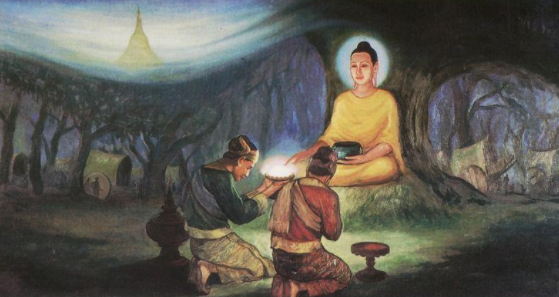
"Once, the Buddha was in the Jetavana monastery, in the garden of Anathapindika, in the kingdom of Savatthi.
At that time, the Buddha addressed the monks:
- There are two types of people in the world who are never satisfied and meet their end. What are these two? They are those who hoard wealth and those who like to give away what they have. These are the two types of people who are never satisfied and meet their end.
At that time, a monk asked the Buddha:
- Venerable Sir! We do not understand this brief statement. What does it mean to hoard wealth? What does it mean to give away what one has? We humbly request the Buddha to elaborate on this meaning.
The Buddha said:
- Listen, listen carefully, and ponder! I will explain this meaning to you.
- Yes, Venerable Sir.
At that time, the Buddha taught the monks:
- Here, there is a person of noble birth who learns various skills, such as farming, writing, accounting, astronomy, geography, divination, or serving as an envoy or minister. They endure heat and cold, hunger and thirst, and hardship to earn a living. This person, after exerting effort and acquiring wealth, dares not spend it, nor give it to their wife and children, nor to servants, nor to relatives. They give to no one. Their wealth may be confiscated by the king, stolen by bandits, destroyed by fire or flood, scattered elsewhere, bringing no benefit, or even within the household, someone may squander it, and it cannot be kept forever. This, O monks, is a person who hoards wealth.
Now, what does it mean to distribute wealth? There is a person of noble birth who learns various skills, such as gardening, writing, accounting, astronomy, geography, divination, or serving as an envoy or minister. They endure heat and cold, hunger and thirst, and hardship to earn a living. This person, after exerting effort and acquiring wealth, distributes it to sentient beings, provides for parents, servants, wife, and children, and also generously supports monks and brahmins, performing meritorious deeds and cultivating heavenly blessings. This, O monks, is a person who distributes wealth. This, O monks, is the meaning of the two types of people who are never satisfied. As for the first type, who hoards wealth, O monks, remember to shun them. As for the second type, who distributes wealth generously, O monks, you should emulate this practice. Thus, O monks, learn this!
At that time, the monks, having heard the Buddha's teachings, joyfully accepted and followed them.
(Anguttara Nikaya, Volume I, Chapter on Shame and Fear of Wrongdoing, VNCPHVN edition, 1997, p. 260)
Clearly, if one 'hoards wealth and is never satisfied,' one loses merit. Oneself and loved ones do not enjoy the fruits of labor that they rightfully deserve. Not only that, hoarding wealth intensifies greed. When one departs, the wealth goes to another's home. Conversely, if one 'distributes wealth and is never satisfied,' one gains merit. One enjoys peace in this life and in future lives.
The Buddha clearly pointed out two types of people who are never satisfied: those who hoard wealth and those who distribute wealth. He taught that one should shun the former and emulate the generous giving of the latter. Therefore, Buddhist disciples always practice generosity according to circumstances, one of the fundamental wholesome practices (faith, learning, morality, generosity, wisdom) for happiness and peace in this life and the next.
According to the Buddhist Information Portal