Introduction
This article aims to review the history of Esoteric Buddhism in China and to investigate the relationship between Esoteric Buddhism and Vajrayāna, as these terms have been and are being used to refer to scriptures, concepts, and practices in Chinese Buddhism. The intended audience for this article is scholars or those who may know a great deal about Vajrayāna in Tibet and Bhutan, but may know little about Esoteric Buddhism in China. This article is also for those who wish to learn about Chinese Esoteric Buddhism.
The character mì (密), like many other Chinese characters, has a fairly broad range of meanings, including 'secret', 'mystery', 'mysterious', and even 'dense', 'thick'. In the Buddhist context, 'Mìjiào' (密教) is often contrasted with Xiǎnjiào (顯教). Xiǎn means 'manifest', 'clear', 'visible'... A reasonable gloss for Mìjiào is 'a doctrine whose meaning is not obvious and requires some interpretation or explanation'.
If you look up the terms Mìjiào and Mìzōng in Chinese-English dictionaries, including specialized Buddhist dictionaries, you will find them translated not only as 'Esoteric Buddhism' but also as 'Vajrayāna', 'Tantra', 'Tantrism', or 'Tantric Buddhism' (1) . However, the terms Mìjiào and Mìzōng are not entirely synonymous with Vajrayāna or Tantra. The former terms have a much broader scope of reference. For example, the Esoteric Buddhism section in the Taishō Tripitaka (volumes 18-21) (2) contains 573 scriptures, many of which, as we shall see, cannot be considered Vajrayāna in the usual understanding of these terms.
The great masters of the Tang dynasty, Vajrabodhi and Amoghvajra (8th century CE), and their disciples sometimes used the term Vajrayāna for some of their doctrines, as did later translators during the Northern Song dynasty, but generally Vajrayāna was not widely used in Chinese, and Mìjiào/Mìzōng were the much more common terms.
For convenience, in this article we will use the terms 'Mìjiào' and 'Mìzōng' (3) . We will also use the term 'Vajrayāna' without systematically distinguishing between the two.
We will begin by examining Esoteric Buddhism in the 8th and early 9th centuries during the Tang dynasty, when it reached its peak of development and influence. We will then consider some elements of Esoteric Buddhist doctrine that were transmitted to China before this period, before moving on to consider the longer-term influence of Esoteric Buddhism up to the present day. For all these matters, we draw heavily on authoritative works in English, particularly by Orzech, Sørensen, Hjort, Payne (2006, 2011), and works in Chinese, particularly by Wang (2017) and Shi (2017). We will also provide brief summaries of concepts and practices as described in some of the key Esoteric Buddhist scriptures in the Taishō dating from different periods.
The history of Esoteric Buddhism in China is fairly well known, although to some extent it was influenced by the Japanese Shingon tradition. Esoteric Buddhist doctrines, like those of other Buddhist schools, originally stemmed from Buddhist centers in South Asia which are now part of India, Pakistan, Nepal, and Kashmir. Monks (often) traveled along the Central Asian trade routes (the Silk Road), passing through Buddhist centers such as Khotan, Kucha, Dunhuang, and entering China via the Yumen Pass (at least until the Tang dynasty). Alternatively, they traveled by sea via Southeast Asia, often via the Buddhist kingdom of Srivijaya on the island of Sumatra, entering China via Guangzhou in the south. Upon arrival in China, they taught and translated into Chinese the scriptures they brought with them, often in collaboration with local monks and scholars. Some Chinese monks also traveled in the opposite direction, either as far as the Indian subcontinent, or to Buddhist centers in Central Asia or Southeast Asia, to bring back scriptures. The translation of scriptures referred to as 'mì' (密) began in the 3rd century CE and continued until at least the Northern Song dynasty (960-1127). Many of these scriptures can also be found in the Tibetan canon, but there are also many scriptures that exist only in the Chinese canon (Giebel, 2011, p.29).
Esoteric Buddhism in the Tang Dynasty
Esoteric Buddhism reached its peak of development and influence in the 8th and early 9th centuries during the Tang dynasty. This was the era of the three great masters Śubhākarasiṃha, Vajrabodhi, and Amoghavajra and their disciples.
Śubhākarasiṃha is said to have come from Orda in Eastern India (though sources disagree) and spent some time studying at Nālandā University, where he became a disciple of Dharmagupta and studied Esoteric Buddhist doctrines with him. He traveled along the Central Asian route to the Tang capital of Chang'an in 716 CE. Shortly after his arrival, he began the work of translating into Chinese the Sanskrit scriptures he brought with him. He was patronized by the emperor and in 724 accompanied the emperor to the secondary Tang capital of Luoyang, where he translated the Mahāvairocana Abhisaṃbodhi Tantra, or the Mahāvairocana Sūtra (Taishō 848), with the assistance of his Chinese disciple Yixing. They subsequently translated other scriptures related to the Mahāvairocana Sūtra, and Yixing wrote a commentary on this sutra. The Mahāvairocana Sūtra, along with another sutra translated by Śubhākarasiṃha, the Susiddhikara Sūtra, are two of the three most important scriptures of Tang dynasty Esoteric Buddhism and later of the Japanese Shingon sect.
In the Taishō, the Mahāvairocana Sūtra is the first scripture in a group of related scriptures titled Mahāvairocana (大日), and it is by this name that the sutra is widely known. Mahāvairocana is the translation of Mahāvairocana, while Vairocana (毘盧遮那) is the transliteration of the word Vairocana.
The sutra begins with a dialogue between Vajrapāni and Mahāvairocana in which the conceptual basis for the doctrine is laid out. Vajrapāni asks Mahāvairocana how he attained sarvajñatā (一切智). Mahāvairocana explains that bodhicitta is the cause, compassion is its root, and skillful means is its highest point. He goes on to explain that bodhi means knowing one's mind as it truly is, equivalent to anuttarā samyaksaṃbodhi. However, it cannot be grasped (得), because bodhi has the characteristic (相, Skt. lakṣaṇa) of emptiness and no one can comprehend it. In fact, all phenomena are signless.
The subsequent sections will detail the appropriate means or practices that can lead to such an enlightenment. These include the establishment of mandalas, recitation of mantras, mudrā, initiation rituals, and visualization of Buddhas or Bodhisattvas.
The main mandala in this sutra is the 'Mandala born from the womb (Skt. garbha ) of great compassion (大悲胎藏生曼荼羅)', commonly known simply as the Garbhadhātu (胎藏界). There are detailed instructions on the preparation and establishment of the mandala, including the qualities and attainments that the participating master and his disciples must possess, the preparation of the site, the mantras to be recited, and the Buddhas to be visualized. First is Vairocana (大日, Vairocana) and then the Buddhas of the four directions - Ratnaketu (寶幢, Ratnaketu) in the East, Saṃkusumita (華開敷, Saṃkusumita) in the South, Akṣobhya (不動佛, Akṣobhya) in the North, and Amitāyus (無量壽, Amitāyus) in the West. It also includes instructions on how to draw the circles of the mandala.
A complete English translation of this sutra can be found in Giebel (2005).
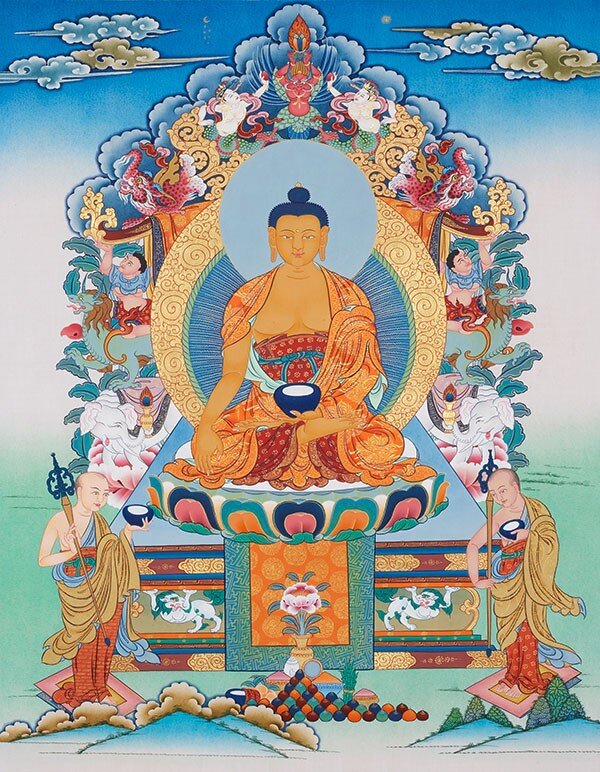
A Tibetan version of this sutra exists, translated about a century after the Chinese translation. However, the Tibetan version lacks the seventh fascicle of the Chinese version, which is a ritual manual preserved as a separate work in the Tibetan Buddhist Canon. On the other hand, the Tibetan translation contains the "Treatise on Buddha-nature" (Uttara-tantra) which is not present in the Chinese version (Giebel, 2005, p. xiv). In Tibet, the Mahāvairocana Sūtra is classified as a Caryātantra. However, China does not have this four-part classification of tantras of Tibet and in fact does not even distinguish tantra from sūtra. All of them are labeled as kinh (經), which in the Buddhist context is the common translation of the Sanskrit word sūtra.
Two other great masters of the Tang dynasty, Vajrabodhi and his disciple Amoghavajra, arrived in the Eastern Tang capital of Luoyang in 720, just four years after Śubhākarasiṃha. They arrived by sea route via Srivijaya and entered China via Guangzhou. According to one source, Amoghavajra was from South India and also spent time at Nalanda University. He is said to have received esoteric initiation in South India from Nāgabodhi. In China, he received imperial favor, and the Tang emperor bestowed upon him the title "National Preceptor", a title the emperor granted to outstanding Buddhist monks (Shi, 2017).
Vajrabodhi is said to have tirelessly propagated the teachings of Esoteric Buddhism. He traveled to many temples to establish altars for abhiseka (灌頂, Skr. abhiṣekha), which means "opening the mind" or "transmission of faith". He performed such an abhiseka for Emperor Xuanzong of Tang, as well as for many monks, nuns, and laypeople. He also became famous for performing many efficacious rituals and was invited by the court to perform rain-making and healing rituals for a princess (Shi, 2017). Together with his disciple Amoghavajra, he translated the Vajraśekhara Sūtra (金剛頂經), as well as many other scriptures.
The full title of the Vajraśekhara Sūtra is Vajraśekhara Sarvatathāgata-tattva-saṃgraha-nāma-mahāyāna-uttara-tantra-śāstra-rāja-sūtra (金剛頂一切如來眞實攝大乘現證大經王經). The sutra also emphasizes Mahāvairocana, who is presented at the beginning of the sutra as teaching a vast assembly of Bodhisattvas. Some of them approach Shakyamuni (under the esoteric name Sarvartha Siddhi) while he is meditating under the Bodhi tree at the point of enlightenment. They instruct him in esoteric rituals that offer a more direct path to enlightenment. As in the Mahāvairocana Sūtra, various rituals are described in detail and include initiations, mantras, mudras, and the establishment of mandalas. The central mandala of the Vajraśekhara Sūtra is the Vajra Dhātu (金剛界). Giebel also translated this sutra into English (Giebel, 2001).
Vajrabodhi and Amoghavajra gave many teachings based on the Vajraśekhara Sūtra and related scriptures. This sutra became one of the central scriptures of Tang Esoteric Buddhism and later of Japanese Shingon, where the Vajra Dhātu mandala of the Vajraśekhara Sūtra is seen as complementary to the Garbha Dhātu (胎藏界) mandala of the Mahāvairocana Sūtra. Vajrabodhi died in 741.
If Śubhākarasiṃha and Vajrabodhi laid a solid foundation for Tang Esoteric Buddhism, it was thanks to Amoghavajra and his disciples that it flourished and reached its peak. Amoghavajra seems to have had connections with Central Asia, and according to one source, his father was an Indian merchant and his mother was Sogdian. Although he spent much time in the capital Chang'an, he also traveled to many other places in China to establish altars for abhiseka and performed many initiations for monks, nuns, and laypeople. At the request of Emperor Xuanzong, he set up altars for abhiseka and performed Homa (fire rituals) in the palace and conferred abhiseka upon the emperor himself. Amoghavajra was also famous for developing Mount Wutai (五臺山) into a major center of Esoteric Buddhism. He died in 774.
The teachings of these three Tang masters and their disciples are called Zhenyan school (真言乘) or simply Zhenyan. Zhenyan, literally "true word", is a translation from the Sanskrit mantra. Therefore, Zhenyan school can be translated as Mantrayāna, which indicates the importance of mantras in their teachings. These teachings are also known as Tangmi (唐密), meaning Tang Esoteric Buddhism.
Shingon is the Japanese pronunciation of the two characters 真言 (Zhenyan) and is the name by which these doctrines and their lineages continued to spread and develop in Japan, although Mikkyō, the pronunciation of the two characters 密教 (Esoteric Buddhism), is also used. These doctrines were brought to Japan by the Japanese monks Kūkai (空海, 774-835) and Saichō (最澄, 767-822); they traveled to China during the Tang dynasty and studied Esoteric Buddhism. Kūkai received abhiseka from Amoghavajra's disciple Huiguo (惠果) and studied with him as well as with Śubhākarasiṃha's disciple Xuanchao (玄超), thus enabling him to combine the Vajra Dhātu and Garbha Dhātu teachings. He is considered the founder of the Japanese Shingon school. Saichō received abhiseka and studied Zhenyan with Shunsho (順曉). Upon returning to Japan, he founded the Japanese Tendai school, incorporating Esoteric Buddhist practices into Tendai.
Tang Esoteric Buddhism and Vajrayana
The concepts and practices in the Esoteric Buddhist scriptures associated with the three Tang masters appear to have all the essential characteristics of Vajrayāna, although we do not know for certain whether these doctrines were considered distinct schools at the time. The main content of these scriptures is to reveal, discover, or realize the Buddha-nature or inherent enlightened essence within one's mind, capable of being realized in this very lifetime. This is achieved through the deployment of practices such as mudra, mantra, and mandala, symbolizing the "three mysteries" (三密) of body, speech, and mind, as well as visualizations of Buddhas or Bodhisattvas and other rituals specific to Esoteric Buddhism, such as the Homa ritual. All of these are systematized into a path with the aim of salvation, accessible only through abhiseka (initiation) rituals performed by a qualified master.
However, it should be noted that Tang Esoteric Buddhism (and thus the Shingon sect) lacks Annuttarayoga Tantra, the highest class of Tibetan Vajrayāna (4) . Therefore, from a Tibetan perspective, Tang Esoteric Buddhism can be seen as representing only an incomplete or partial Vajrayāna. Indeed, some Chinese masters who reintroduced Shingon or Esoteric Buddhism to China in the 20th century seem to have subsequently found it necessary to combine what they brought back from Japan with the study of Tibetan Vajrayāna.
Esotericism Before the Three Tang Masters
The Esoteric section of the Taisho Tripitaka contains many translations dating from before the scriptures related to Tang Esoteric Buddhism or Shingon of the 8th and 9th centuries, and scholars have noted the fact that many of the "esoteric" practices focused on Shingon existed prior to this period.
Such esoteric practices include the chanting of dharani (咒). Dharani is a rather general term that basically means spell, magic, charm, and even curse, but has been and is used in Chinese Buddhism to refer to both mantra and dhāraṇī (these two terms are not clearly distinguished). Initially, a spell would be transliterated according to the sound of the original Sanskrit (or other language) using Chinese characters chosen purely for their phonetic similarity to Sanskrit, without regard to their meaning. These characters were pronounced according to various common Chinese pronunciations of the time, most likely the Middle Chinese pronunciation spoken in the capital. When such spells are chanted today, the modern pronunciation of the characters is usually used, often Mandarin (普通), but sometimes other dialects such as Cantonese. Of course, these pronunciations differ greatly from the original Sanskrit sounds, although there have sometimes been attempts to reconstruct the original Sanskrit pronunciation and use that.
The first scripture containing spells, the Mātaṅga Sūtra (Mātaṅga, 摩登伽經), was translated as early as 230 CE. Nearly a century later, in 310, Fotudeng (佛圖澄), a monk from Central Asia, arrived in Luoyang and persuaded Shi Le (石勒), the founder of the Later Zhao kingdom, to take him into his service. Fotudeng used his supernatural abilities to advance the political and military ambitions of Shi Le and his successor, and he became famous for using spells to pray for rain, heal illnesses, drive away evil spirits, and invoke blessings. Although Fotudeng is not credited with any translations, he was the first to receive significant imperial patronage for Buddhism and is said to have been responsible for building many temples and receiving official recognition to ordain Chinese monks.
Over the next two or three centuries, there were many scriptures containing spells that were translated, primarily used for the purpose of warding off various kinds of evil spirits or for receiving blessings. One scripture, according to Kieschnick (2017), possibly dating from the first half of the 6th century is the Miscellaneous Collection of Dharanis (陀羅尼雜集, T 1336); this is a large compilation of dhāraṇīs (dhāraṇī, 陀羅尼) and spells (神咒). The dhāraṇīs were given by various Buddhas and Bodhisattvas, and the scriptures provided instructions for their use, explanations of their powers, and their purposes. The collection includes spells for healing, difficult childbirth, praying for rain, treating snake and scorpion bites, etc.
Although they are said to have been spoken by Buddhas and Bodhisattvas, these dhāraṇīs/spells, aimed at purely worldly purposes, are of course essentially "magical" spells (thaumaturgy), and it is difficult to see them as Vajrayāna practices. However, some spells in the collection are described as leading to progress on the Bodhisattva path, and we can see them as the embryonic form of the practice of chanting spells or dhāraṇīs in the Shingon systems. For example, regarding the sixth spell in the collection, given by Dipamkara Buddha, the scripture states:
"... Those who practice chanting this dhāraṇī and those who have not yet made vows to attain enlightenment will all make this vow and will not regress. Those who have previously made this vow, if they practice this dhāraṇī, will pass the seventh stage, even reach the tenth stage. This dhāraṇī is Vajra samadhi, the gateway to the liberation of great emptiness. A Bodhisattva, from the time they first make the vow, will practice this samadhi from the time they go to the place of enlightenment, under the Bodhi tree, until they enter Vajra samadhi [and become a Buddha]." (Translated from Kieschick, Supplement: Esoteric Texts, p.15, 2017).
From the 5th century onwards, we see Esoteric rituals becoming more complex, including the establishment of ritual platforms and altars dedicated to the chanting of spells. Initially, practitioners simply offered incense and flowers before the Buddha and chanted spells, then mudras were added, followed by the Homa ritual (fire offering). The rituals became more elaborate, and by the Sui dynasty and early Tang dynasty (7th century), mandala ritual platforms had developed with altars surrounded by images of "honored ones" (諸尊), i.e., Buddhas, Bodhisattvas, and other deities of Esoteric Buddhism (Shi, 2017).
One example is the Collection of Dharani Sūtras (陀羅尼集經 T901), a Tang dynasty compilation of dhāraṇīs/spells which contains scriptures translated during the period 653-654 by Atikūṭa (阿地瞿多), a monk from Central India. The scriptures in the collection contain many Esoteric practices that were later developed in the Shingon sect. There are dhāraṇīs for various Buddhas, Bodhisattvas, and celestial beings combined with mudras. There are detailed instructions for setting up ritual platforms and altars for chanting dhāraṇīs/spells beforehand, as well as other rituals. The spells are said to achieve spiritual power (神力), "spiritual" or "supernatural" power.
Orzech summarizes the developments of Esotericism in the early Tang period (founded 618 CE) as follows:
"First, we see the translation of many scriptures showing an increasing interest in spells and dhāraṇīs. Many of these scriptures focus on a specific dhāraṇī, ritual, and deity. Second, we see the emergence of scriptures representing distinct and comprehensive systems that aim to systematize the rising wave of Esoteric scriptures, deities, and techniques. Full access to these systems is only through the abhiseka (initiation) ritual, performed by ritualistically transforming a disciple into a cosmic lord. Third, these comprehensive systems were accepted by the emperor for twenty years, from 760 to 780." (Orzech, 2011, p.265)
Thus, it is difficult to draw a clear line between, on the one hand, what we can consider Vajrayāna Buddhism as represented by Shingon teachings, and on the other hand, Esoteric Buddhism in general. Early forms of esoteric practice gradually became more complex and were eventually incorporated into comprehensive systems. At the same time, the purpose of the practices shifted from purely worldly to achieving various spiritual attainments and progress on the Bodhisattva path, and ultimately to the realization of Buddhahood.
Later Developments
During Emperor Wuzong's persecution of Buddhism in the mid-9th century, the Shingon lineages suffered particularly severe difficulties. However, for a time, it seems that some lineages continued until at least the Song dynasty, especially in areas far from the capital. In the early 11th century during the Northern Song dynasty, there was another wave of Buddhist scripture translation, including tantras. However, they seem to have had little impact at the time. Nevertheless, the practice and influence of some aspects of Esoteric Buddhism continued. There are at least three contexts for this.
First, for centuries there have been scattered activities of groups, often led by reputable masters, focusing on the worship of specific Esoteric Buddhist Buddhas or Bodhisattvas, with rituals including mudras, mantras, and mandalas. For example, Robert Gimello (Gimello, 2004) has described the prevalence of the worship of Bodhisattva Cundī, using dhāraṇīs, mantras, and mandalas associated with Her, up to the 17th century, during the period between the fall of the Ming dynasty and the establishment of the Manchu Qing dynasty.
Second, there has been a revival of Tang Esoteric Buddhism (唐密: Tang Esoteric Buddhism) in China and in other Chinese-speaking communities based on Japanese Shingon and Tendai teachings. This began in the early 20th century during the Republican period and can be seen as part of a project to reform and "modernize" Chinese Buddhism by re-examining and re-evaluating tradition (Bianchi, 2004). Some monks and laypeople went to Japan to study Shingon and Tendai sects and spread the teachings in China upon their return. One notable monk among them was Da Yong (大勇), a disciple of Taixu (太虛), a great 20th-century master and reformer of Chinese Buddhism. Da Yong went to Japan in 1921 and the following year studied at the Esoteric Buddhist University on Mount Kōya (高野山密宗大學), where he learned both the Vajra Dhātu mandala and Garbha Dhātu mandala systems from Kanayama Bokushō (金山穆韶/Kim Sơn Mặc Thiều) and was awarded the title of Ācārya. He returned to China in 1923, established abhiseka platforms, and performed abhiseka ceremonies in Shanghai and Hangzhou, and later, at the invitation of Master Taixu, taught Esoteric Buddhism at the Wuchang Buddhist Academy. Not long after, he also began studying Tibetan Vajrayana and spent the rest of his life integrating the practices of the Japanese and Tibetan Esoteric traditions (Deng & Wang, 2016).
Another monk who traveled to Japan around the same time was Te Song (特松). He also studied with Kanayama Bokushō and was awarded the title of Ācārya. Upon returning to China, he propagated Esoteric teachings, conferred abhiseka, and performed Esoteric rituals for the protection of the nation. Later, he also studied with a Tendai master. Te Song wrote more than ten books on Esoteric Buddhism.
A layperson, Wang Hongyuan (王弘願), translated the Essentials of Esoteric Buddhism (密宗綱要, 王 1981/2007) by the Shingon monk Gonda Raifu in 1918. This was the first Chinese work on the Japanese Shingon sect (Bianchi, 2004). The book is still widely popular in Hong Kong and Taiwan.
Later, events in the 20th century, particularly the so-called Cultural Revolution in the late 1960s and early 1970s, more or less put an end to the practice of Tang Esoteric Buddhism in mainland China. However, it survived in Hong Kong and Taiwan, and has since seen a limited revival in mainland China (5) . In Hong Kong, Shingon centers do not usually establish their own lineages. They maintain close ties with Japanese Shingon and sometimes send practitioners to Japan for study. In Taiwan, however, the Shingon Komyo lineage (真言光明流) founded by Master Wu Guang (悟光上師) does not identify itself as Japanese Shingon. Instead, this lineage considers itself a revival of Tang Esoteric Buddhism. This lineage has over 6,000 members and its influence has spread throughout Chinese-speaking regions (Bahir, 2018).
The third way in which the influence of Esoteric Buddhism persists in modern China is through the integration of Esoteric doctrines and practices into other schools. Tendai was the first school to do this, but the two dominant schools of Chinese Buddhism, the Pure Land school and the Chan school, also incorporated elements of Esoteric Buddhism.
A prime example is the Śūraṅgama Sūtra, commonly known in China as The Buddha spoke the Great Buddha Crown Shurangama Sūtra (大佛頂首楞嚴經, T945), often abbreviated as the Shurangama Sūtra (楞嚴經).
Although the Shurangama Sūtra is found in the Esoteric section of the Taisho Tripitaka, it is considered a core scripture of the Chan school and is in fact one of the most influential sutras in modern Chinese Buddhism. According to Master Hsuan Hua (宣化), abbot of the City of Ten Thousand Buddhas in California until his death in 1995 and founder of the Dharma Realm Buddhist University, the Shurangama Sūtra is often the first major scripture studied by newly ordained monks in Chan monasteries at least since the Ming dynasty. It is also studied by laypeople.
Master Hsu Yun (虛雲), a Chan master and influential teacher in the late 19th and early 20th centuries, promoted the study of this sutra and the practice of chanting the mantra within it. Later, Master Hsuan Hua was also a strong proponent of this sutra and the mantra within it. When he arrived in San Francisco, his first task was to lecture on the Shurangama Sūtra, and in 1968, he organized a 90-day retreat focused on this sutra. The Buddhist Text Translation Society (BTTS) produced an English translation of this sutra under the guidance of Master Hsuan Hua, published along with excerpts from his commentary (BTTS, 2009).
According to Master Hsuan Hua: "In Buddhism, all sutras are very important, but the Shurangama Sutra is the most important. As long as the Shurangama Sutra exists, the Dharma will remain in the world. Whenever the Shurangama Sutra is gone, the Dharma-ending age appears before our eyes" (6) .
This sutra is broad in scope, drawing ideas from various Mahayana Buddhist schools. A central concept of the sutra is the Tathāgatagarbha (如來藏) inherent in all beings, from which the illusory world of mental and physical phenomena arises. The Tathāgatagarbha also contains our potential for enlightenment as our practices remove the layers of illusion. This view is compatible with both the Vajrayāna path leading to enlightenment and with Chan techniques for "directly pointing to the human mind" (直指人心), i.e., how a master reveals to disciples by directly revealing their mind-nature.
The most explicit Esoteric parts of the sutra are the mantra The Great White Canopy Buddha Crown Immovable Victorious Mantra of the Great Power, commonly known as the Shurangama Mantra, and the details on how to practice this mantra.
The instructions for setting up the Dharma assembly hall (道場) are long and complex, involving the preparation of various offerings for Buddhas and Bodhisattvas. On the walls inside the room, images of Buddhas in the ten directions are displayed, including, to the south, images of Vairocana Buddha, Shakyamuni, Maitreya, Akṣobhya, and Amitabha.
Practitioners must first receive precepts from a "truly pure" member of the Sangha, trained in methods for achieving samadhi and who has themselves established purity in conduct. For the first seven days, they must circumambulate the Dharma assembly hall, chanting the Shurangama Mantra. For the next seven days, they must focus on Bodhisattva vows, and for the final seven days, they must chant this mantra continuously day and night. On the last day, Buddhas will appear from the ten directions. After three weeks, the practitioners must then sit in meditation for one hundred days. "If their roots in the Dharma are strong, they will not leave their seats during that time and they will become Arhats at the first stage. Even if they do not reach the level of a Sage, it is certain that in the future they will become Buddhas." (BTTS, 2009, p.286).
Although it is an important sutra of the Chan school, the Esoteric elements in this sutra are clear. It includes chanting mantras, constructing a Dharma assembly hall like a mandala with altars surrounded by images of "yidams" (deities), and visualizing manifestations of "yidams." The practices are integrated into a rigorous system aimed at the realization of Buddhahood.
However, it should be noted that the chanting of the Shurangama Mantra is often detached from this context. For example, if you search for the Shurangama Mantra on YouTube, you will find many versions of it, sometimes chanted, sometimes sung, often in the Mandarin pronunciation of the characters, sometimes in Cantonese pronunciation, and sometimes in reconstructed Sanskrit pronunciation. Claims are often made about the various worldly benefits that can be obtained simply by chanting this mantra, including blessings for oneself, one's family, and the nation.
Conclusion
Different forms of Buddhism are often conceptualized taxonomically. That is, there are the three main vehicles – Hinayana, Mahayana, and Vajrayana, each with distinct lineages or schools within it. Or there are the two main vehicles – Hinayana and Mahayana, in which Mahayana is divided into Paramitayāna or Sūtrayāna and Vajrayāna or Tantrayāna. Accordingly, scholars attempt to establish criteria that clearly distinguish between the different vehicles and schools. However, the case of Esoteric Buddhism in China shows the limitations of such an approach.
Within the space of Esoteric Buddhism in China, we find an archetype of Vajrayāna in which the practices of mantra/dhāraṇī chanting, mandala establishment, mudra, yidam practice, and Homa ritual are all deployed and integrated into a system aimed at bringing practitioners quickly to enlightenment, and this can only be achieved after receiving abhiseka from a qualified master and is reinforced by an enlightened worldview through the discovery or realization of the mind-nature.
At varying distances from this archetype, there may be variations that perhaps deploy some, but not all, of these practices and aim at the development of worldly powers rather than supramundane powers of enlightenment. These overlap with "magic" (thaumaturgy) which uses spells or other practices to achieve purely worldly benefits.
In the case of Chinese Esoteric Buddhism, as with any other Buddhist tradition, we will not need to establish definitions with clear criteria that allow us to declare in every case whether such a combination of concepts and practices is Vajrayāna, Esoteric Buddhism, Mahayana, etc.
________
(1) For example, Chen & Li (Eds., 2005; Kleeman & Yu (Eds., 2003).
(2) See https://terebess.hu/zen/szoto/Map-of-the-Taisho.pdf.
(3) For Esoteric Buddhism and related terminology, see Sørensen's *On Esoteric Buddhism in China: A Working Definition*.
(4) Annuttarayoga Tantras do indeed exist in China. The Guhyasamāja Tantra and the Hevajra Tantra are both found in the Buddhist canon (T 885 & T 892). However, both of these texts were translated much later in the early 11th century under the Northern Song dynasty, and these two tantras and the practices they describe seem never to have become popular in China.
(5) See The Development of Tang Esoteric Buddhist Lineages in Contemporary China. http://blog.sina.com.cn/s/blog_64958e4301016gzz.html.
(6) From *On the Authenticity of the Śūraṅgama Sūtra* (http://online.sfsu.edu/~rone/Buddhism/Shurangama/Shurangama%20Sūtra%20Is%20Definitely %20Authentic.htm), as quoted in BTTS, 2009, p.xli.
References
Bahir, C. (2018). “Replanting the Bodhi Tree: Buddhist Sectarianism and Zhenyan Revivalism”. *Pacific World*, 3(20), 95-129.
Bianchi, E. (2004). “The Tantric Rebirth Movement in Modern China: Esoteric Buddhism Re-vivified by the Japanese and Tibetan Traditions”. *Acta Orientalia Academiae Scientiarum Hungaricae*, 57(1), 31-54.
*Buddhist Text Translation Society (BTTS)*. (2009). The Śūraṅgama Sūtra with Excerpts from the Commentary by the Venerable Master Hsüan Hua: A New Translation. Ukiah, CA: Author.
Chen, G. S., & Li, P. Z. (Eds.) (2005). *Chinese-English Dictionary of Buddhism*. Beijing: Foreign Languages Press. Deng, Z. M., & Wang, J. (2016). Tang Esoteric Buddhism in Modern China. 每日頭條. Retrieved from https://kknews.cc/zhhk/culture/z5yk2q.html
Giebel, R. W. (2001). *Two Esoteric Sūtras: The Adamantine Pinnacle Sūtra, The Susiddhikara Sūtra*. Moraga, CA: Numata Center for Buddhist Translation and Research.
Giebel, R. W. (2005). *The Vairocanābhisaṃbodhi Sūtra*. Moraga, CA: Numata Center for Buddhist Translation and Research.
Giebel, R. W. (2011). Taishō Volumes 18-21. In Orzech, C. D., Sørensen, H. H., & Payne, R. K. (2011). *Esoteric Buddhism and the Tantras in East Asia* (pp.27-36). Boston: Brill.
Gimello, R. (2004). *Icon and Incantation: The Goddess Zhunti and the Role of Images in the Occult Buddhism of China.* In P. Granoff & K. Shinohara (Eds.), *Images in Asian Religions: Texts and Contexts* (pp.71-85). Vancouver: University of British Columbia Press.
Kieschick, J. (2017). *A Primer in Chinese Buddhist Writings*. Stanford, CA: Stanford University. Retrieved from https://religiousstudies.stanford.edu/people/johnkieschnick/primer-chinese-buddhist-writings.
Kleeman, J., & Yu, H. (Eds.). (2003). *The Oxford Chinese Dictionary*. Oxford: Oxford University Press.
Orzech, C. D., Sørensen, H. H., & Payne, R. K. (2011). Esoteric Buddhism and the tantras in East Asia. Boston: Brill.
Payne, R. K. (2006). Tantric Buddhism in East Asia. Boston, MA: Wisdom Publications.
釋悟光 Shi, W. G. (2017). 密教史 (A history of esoteric teachings) . Hong Kong: 資本文化有限公司 (Capital Culture).
王弘願 Wang, H. Y. (2017). 密宗綱要 (An outline of Esoteric Buddhism). (2nd ed.). Taipei: 天華出版社 (Heavenly Lotus Publishing).
(NSGN 347)